Curse of Capitalism

Capitalism is a totalizing and comprehensive economic system that governs our daily lives, guides governmental policy, shapes institutional values, and demands technological growth. The system’s emphasis on competition and innovation on the market has spurred innovation and entrepreneurship, and fortunate individuals have become enriched in the process. While some lucky capitalists use their economic advantages to uplift others and pursue equality, the economic system as a whole greatly incentivizes private ownership, wealth accumulation, and the exploitation of the poor. As such, the wealthy establish monopolies, market barriers, and legislations to consolidate power and protect their fortunes. In this paper, I will explain how capitalism exacerbates inequality and permits the rich to pursue unfair advantages that prevent social mobility and deepen the gap between the wealthy and the indigent.


Capitalism is often touted as a force that encourages people to find creative solutions to difficult problems because, unlike other economic organizational approaches, it forces actors to compete with one another to “earn” both the necessities of food, housing, medicine and the luxuries of non-essential goods and services. Yet, the flipside of this competitive structure is that legions of people are poor while a minute segment of the population become billionaires. To defend a system that creates such disparities in the social distribution of wealth, economists will often cite Adam Smith’s arguments, which posit that capitalism offers a means by which supply and demand for certain products and services find their equilibrium (Smith). According to this logic, people are paid a wage based on the social value of their labor, so people who create “innovative” products are rewarded with greater sums of money.


A rebuttal to Smith’s viewpoint is the observation that this argument justifies inequality by suggesting that those who happen to control the means of producing commodities also deserve to reap all the value realized by those commodities on the market (Gans). In fact, capitalists gain money by reducing the expenditures necessary to produce the commodities or services they sell, and these reductions must be driven by increasing efficiency or cutting production costs – in other words, intensifying the labor process at lower total wages (by cutting salaries or shedding jobs). Competition requires these mechanisms, because those capitalists who neglect to perform these interventions will go out of business. Wage laborers who supply goods that are in high demand, then, do not reap the “value” represented by the price and quantity of those goods sold; rather, they are excluded from these gains because their exploitation is required for those fortunes to be accumulated in the first place.


This form of wage-labor exploitation is dramatically represented in the differences in pay between the average chief executive officer (CEO) and the average worker. In the mid-1960s, it would take the average worker 20 years to earn the annual earnings of the average CEO (Lawrence). Today, this figure has drastically increased to an impossible 312 years, meaning the average worker would need to work over three centuries to match their boss’ single-year paycheck. The gap between the wealthiest capitalists and the masses of laborers is wider than ever, and this inequality is perpetuated by capitalism itself.


Inequality is also allowed to run rampant in the capitalist system because of its exclusion of legislative interventions that would redistribute wealth to those in need. A strict, Adam Smithian approach to the market would advocate for a free interchange of goods and services without any governmental intervention. Competition can flourish and companies are spurred to develop, innovate, and grow through entrepreneurial verve and creative approaches to meeting social needs. However, the truth is that untrammeled competition permits actors to form monopolies, oligarchies, and barriers to market entry to stifle competition and accelerate exploitation. Mergers and acquisitions between large firms ostensibly in different industries, such as Amazon and Whole Foods, permit single entities to control vast swathes of the means of social production and reproduction (Banerjee). Instead of innovating, these companies have created a business model that revolves around reducing competition as much as possible.


One deleterious consequence of this phenomenon has been the massive increase in corporate power. These firms pursue economic gain at the expense of other community stakeholders, such as workers and local residents (Stiglitz). For instance, when Walmart enters a small town, it uses its economic advantage and massive supply chain infrastructure to offer lower prices and drive all other locally owned enterprises out of business. Once all competition is driven out, Walmart is no longer incentivized to innovate, provide variety, or reduce prices. Instead, the company will focus on erecting barriers to entry and increasing profits in the most sustainable and efficient manner. Consumers will then be forced to pay higher prices, workers will be forced to work at lower wages, and product quality will decrease. The texture, character, and life of the town will also decline since the people with real, local stakes in the well-being of the community will no longer be able to run the kinds of unique businesses that give places their soul.


While Walmart is just one large company that implements these sorts of policies and strategies, there are a myriad of other firms that follow suit. The Columbia University economist Joseph Stiglitz emphasizes how monopolized market power permeates our daily lives: “we see it in the limited choices we face for cable TV or the internet or telephone services. Three firms have an 89 percent market share in social networking sites, 87 percent in home improvement stores, 89 percent in pacemaker manufacturing, and 75 percent of the beer market; four firms have 97 percent of the dry cat food market, 85 percent of the jelly market, and 76 percent of domestic airlines revenue” (Stiglitz 66). As a result of public inaction and deregulation, many firms have stopped innovating altogether. For far too long, these industries have stagnated, enriching the victors while impoverishing the vast majority of people, all in the name of competition and market freedom.


Defenders of free-market economies and will often argue that companies that create useful products should be rewarded with freedom and wealth, as these incentives are necessary to spur lifesaving goods and life-improving technologies. Yet, the truth is that these companies abuse their advantages to exploit their market position (Chang). Turing Pharmaceuticals, for example, infamously researched a suite of drugs with expired patents that had already been approved by the Food and Drug Administration. Turing then purchased bulk supplies of these drugs, taking advantage of the expired patents to monopolize the market for them (Pollack). One such drug was Daraprim, which is used to treat toxoplasmosis. Under CEO Martin Shkreli, Turing hiked the price from $13.50 to $750 per pill after buying a majority of the world’s supply of this product (Fox). When other firms tried to compete with Turing by developing generic equivalents of Daraprim, they faced the costly barrier of needing to build production lines and infrastructure. This lag permitted Turing to continue selling the drug at exorbitant prices even after generic firms finally managed to overcome the costs to produce Daraprim.


Due to Shkreli’s incompetence and greed, Turing’s competitors were eventually able to enter the market and lower Daraprim’s prices. Shkreli miscalculated by increasing the price too high, gaining attention and attracting entrants; however, if he had raised the price to, say, $100, it’s likely that Turing would not have gotten the same media attention and could have persisted in exploiting its monopolistic advantage over consumers of this essential medicine. Turing’s scheme demonstrates how capitalists can use deceitful and exploitative practices to capitalize on the needs of society and use a lack of regulation to pursue profits off the backs of defenseless workers and consumers.


Other defenders of capitalism argue that the processes of globalization, international trade, and worldwide competition creates better standards of living across the world. However, these same forces actually permit firms to exploit workers even further by transferring labor to countries with lower minimum wages and even fewer protections and regulations for the proletariat. When companies export jobs, they lower costs without any concomitant need to reinvest these savings in helping those in need on either a local or global level. While some new jobs are created abroad, many are likewise lost at home. The net result for domestic workers is a loss (Stiglitz). For this reason, when China was admitted into the World Trade Organization in 2001, American unemployment increased, while the average wages decreased in the industries in which China exports products (Bower). Furthermore, the financial savings of offshoring weren’t invested in American communities; instead, this wealth remained at the top of the corporate hierarchy. Unrestricted forms of globalization also reduced tax revenue and weakened the government’s ability to help people (Schor). The corporate tactic of asking countries to bid against one another for the “right” of hosting that firm’s operations became a tactic for evading taxes. As a result, inequality increased while incomes declined (Stiglitz).


A potential counterargument to the contention that offshoring hurts the American economy and leads to declines in social life would be the view that manufacturing produces negative externalities in the immediate environment. By moving pollution abroad, this argument would contend, offshoring actually produces advantages for American people. However, this premise neglects to understand the global nature of climate change and impending ecological cataclysm; one country cannot insulate itself as if it lives on another planet. Furthermore, such a callous belief in the American ability to export pollution belies the underlying assumption that environmental sustainability is always an inefficient corporate practice. Under capitalism, slowing production or making technological expansion more expensive is always disincentivized, even if such measures are responsive to the fact that climate change is threating humankind (Stiglitz). Throughout American history, conversely, firms have been incentivized by capitalism to pollute the environment. DuPont, for example, knew about the pollutant Perfluorooctanoic acid, which it emitted “in the local water supply… and in dust from the factory chimney, yet did not disclose this to workers or the surrounding public. According to a 2004 study by an industry risk assessor hired by DuPont, the plant dumped and emitted over 1.7 million pounds of PFOA between 1951 and 2003” (Board). Millions of lives were affected, and future generations will bear the burden of this action. This was the price DuPont was willing to accept in exchange for profits. Hence, while some individuals had something to gain, many had much more to lose. In a capitalist system that advocates for the privatization of wealth, the masses are exploited, and pollution is only one of the many side effects with which the poor must contend.


Capitalism is riddled with internal contradictions and built-in inequities. These problems cannot be ignored. The system is inimical to change and detrimental to the vast majority of people. Rampant inequality and political deregulation are the handmaidens of this economic system. While competition encourages innovation, capitalism uses innovation to leverage the prerogative of the few over the well-being of the many. Furthermore, corporations are able to pursue profits mercilessly, destroying lives and the environment in the process. Therefore, capitalism is inconsistent with addressing the challenges that our society is facing on a global level.
Blockchain Technology in Voting

Kant offers us a theory of enlightenment to understand why we should be able to think freely in society. This theory has supported various innovations throughout society and will continue to explain why humanity is enlightening itself further. In this paper, I will argue that the advancement of blockchain technology is also an advancement of Kant’s theory of enlightenment, by providing people with more incentives to vote and potential politicians with more tools disseminate their views. As blockchain technology empowers both parties, society will become more just. Through reflection on Kantian enlightenment, I will attempt to provide a specific argument for why blockchain eliminates voting bias, and why this will allow for more freedom, which will ultimately grant equality and social justice.

I. Theory of Enlightenment and Voting

Kant argues that a man is enlightened when he can use his knowledge to determine his actions without assistance. During Kant’s time, he perceived many to be unenlightened because guardians or authorities would assist them. Therefore, most individuals would be immature because they primarily relied on others to formulate their thoughts. Kant used the word “immaturity” to describe those who were inclined towards “laziness and cowardice” (Kant 1). He believed that the majority were like this because it was easier to delegate the tasks that required a particular type of skill and logic than to acquire the skills needed for the tasks. This invisible force that had led people to delegate tasks was ultimately the laws and economics governing society’s interactions. Kant specifically blames the “autocratic despotism and profiteering or power-grabbing oppression” which has exploited the public and caused them to remain immature (ibid.). This “power-grabbing oppression” mainly existed because people were easily susceptible to pay others to do their work. Kant considered those who invited this oppression as “cowardly” and enslaved intellectually by authorities (ibid.). On the contrary, those who questioned the oppression and scrutinized why the authorities needed such powers were considered “enlightened” (Kant 2). Kant reasons that these people would test their opinions by validating them with others, who would decide the accuracy of such ideas. Through this process, humanity would improve as a whole and become more enlightened because each member of society would understand an existing viewpoint from the previous viewpoint or viewpoints, which were backed with arguments. This ledger-based concept of validating a current viewpoint using previous viewpoints, which were proved inaccurate by using reason and logic, was the essence of the Kantian message.

The lack of reasoning from the public that Kant describes can be seen throughout many facets of life, one of which is the lack of political participation within the United States. This lack of political participation represents a failure of Kantian enlightenment because by delegating the task to others, man would be intellectually enslaved. In order to become enlightened, man would need to think for himself, without the help of others. One way of demonstrating this ability was by voting. Despite the Kantian view, many still do not vote. The reasons why voting may be unpopular vary from person to person. For instance, some may believe that their vote is insignificant in the sea of votes. Others might argue that “political activity represents only one way among many of pursuing the common good,” so there is no reason for why voting should be an emphasized activity (LaBarge 2). Not to mention that when people do vote, they often vote with knowledge from biased sources, elect candidates who might eventually lose to opponents with greater ties to special interests, or face external problems such as voter fraud. These are only some of the major external issues that voters face when navigating through such an arduous process. Furthermore, there are also a multitude of issues for candidates who desire to represent the public. These issues include the costs of campaigns, prerequisite internal partisan connections, and other bottlenecks, which reduce the number of candidates that voters can choose from. Because of these barriers, potential candidates are unable to introduce their ideas for how best to govern the state even if they wished to, while candidates who are considered more experienced or popular largely dominate the political arena. The aggregation of all these problems that currently exist throughout the system largely disincentivizes voters. Hence, the immense wealth of disincentives creates a voting system that discourages the act of voting and prevents new ideas from reaching the public. In Kant’s perspective, these disincentives merely contribute to people’s ignorance in voting.

I would agree with these views, and I would even elaborate further on them from an analytical perspective. Like many who were born in America, I believe that there are various commitments that need to be made when voting for society’s wellbeing. Although some individuals are able to maintain these commitments when voting, I am not able to do so for a variety of reasons. The first commitment I am unable to preserve is perhaps the time commitment in gathering insightful and unbiased information about candidates, which usually is a difficult process given the volume of information scattered among various media. Examples of such media that are integrated within American culture are the television and the internet, which rarely contain unbiased information. The scarcity of truth from these common sources, which are easily accessible, further complicates my making decisions on any political issue. For example, popular televised political channels might include CNN or Fox News. While both networks have similar infrastructures, they have reporters who have fundamentally different views. Their political reports reflect this dialectical relationship by constantly contradicting one another. When one network has a certain opinion, the other almost always acts as the opposed counterpart. You rarely see ideas from Fox News and CNN in agreement, which is a strenuous problem for those who desire to take a stance on any one issue. Furthermore, sometimes a news network may purposefully lie, exaggerate, or manipulate, solely to present the opposing view and attack the other. This deception adds to the clutter of biased information provided to the public. As a result, if one desires to validate a report from the media about a political cause, they must spend more time to cross-examine on top of what they have already spent listening to or watching the media, which adds on to the long list of economic costs for voting.

Even when I vote for a candidate with knowledge from the mainstream media, there are still various issues. The first is that I will still face the possibility of voting for the wrong candidate. This possibility of incorrectness would not only adversely affect the common good, but also affect me morally. Hence, I would instead remain silent than negatively impact the country. Secondly, if I have spent the time researching a particular candidate, but he or she is eliminated from further participation, the time and effort I have spent will have been in vain. On the contrary, instead of researching political candidates, I could have spent time making an impact for the greater good directly. Furthermore, if this candidate is eliminated and I still am inclined to vote, there may not be an available candidate left who is prioritizing the common good; instead, they might be pushing alternative agendas, either cynically or otherwise. Because of these issues, I delegate this enormous task to other citizens and those who represent me, who I hope are more informed than me. In this regard, I am the type of person that Kant would consider “lazy”. Those who don’t believe in this view will obviously vote either knowing that their opinion may be biased or unaware that their opinion may be subjugated by invisible forces. Therefore, because these factors cause the public to vote inappropriately or simply not to vote, the voting system is only one facet of the various government systems that has been corrupted with inefficiencies.

There is a solution, which if implemented, that will improve not only the problems surrounding voting, but also other controversial issues throughout society as well. The technology that I believe will benefit society is blockchain technology, which if implemented within the government’s voting system will improve the security, transparency, and accountability of the government. These three benefits will allow society to be more enlightened, less “lazy,” and more incentivized to participate within the political realm.

II. Introduction of Blockchain Technology

However, before I elaborate upon how blockchain can benefit the voting system, I will provide an analogy to simplify the technicalities of blockchain. During this simplification, I will assume that only my classmates will read this and that you all have used Google Docs for various classes in the past or are currently using it. If you have not used Google Docs, it is a technology that allows those who have a network-connected computer to produce a document cooperatively or individually.

The first step when two parties decide to use Google Docs is to assign one person to be the administrator, who has full control of the document’s settings. The administrator’s role is similar to that of the blockchain developer’s, who creates the initial framework for the blockchain. Unlike Google Docs, when the blockchain is released to the public, the initial developer is unable to modify its contents. If the administrator were using Google Docs, given this analogy of blockchain, he would be unable to change the words, sentences, or paragraphs after programming the document’s settings. This would be antithetical to Google Docs’ purpose, which is for the administrator or creator to write a new document. Hence, while a group of developers or a developer creates the blockchain, similarly to how the administrator creates the document, the developer should not be able to edit the contents of the blockchain after its release. This lack of central editing authority is the first property of blockchain.

The second step when creating the document is for the administrator to set specific settings such as who has access to the document and whether they can view, edit, or view and edit. The document’s access setting can be simplified into two choices: public or private. A private Google Docs is similar to a private blockchain, and a public Google Docs is similar to a public blockchain. If the Google Docs is set to private, only you can access it. Similarly, if a blockchain is private, only a restricted number of people with certain credentials can access it. However, a difference between the private Google Docs and the private blockchain is that current participants in the private blockchain may grant access to certain individuals in the public by an election-like process. By contrast, if the Google Docs is set to public, anyone can view and download a copy of it. Similarly, the public can view a public blockchain’s contents without permission and download a copy of it. Hence, the private and public customizable aspects satisfy the second property of blockchain.

Furthermore, when participants desire to view specific changes within a public document, they can do so by checking the revision history. Similarly, when the public desires to check previous changes in the blockchain, they can do so by looking at previous blocks. One key aspect of the revision history ledger (attached to every Google Docs) is that it cannot be changed because its data is stored within Google’s servers. Google guarantees the immutability of its data because its employees guard Google’s servers continually. Infiltrating their servers would be extremely costly and almost infeasible. This type of security is known as centralization, in which one party guarantees the security of the ledger; in this case, it is Google. On the contrary, blockchain guarantees the security of its data using cryptography, integrated within each block and transaction. This feature secures the immutability of previous content while also allowing the public to reach a consensus on whether the current content is valid. If after a certain number of participants deem the content to be accurate, the content will be added to blockchain’s ledger. This ability to reach a consensus in a democratic-like manner allows for properties such as transparency and efficiency to exist when recording content.

III. Voting Using Blockchain

My proposal in using blockchain to alleviate the inefficiencies of the voting system may not be the final solution nor the best solution. However, I believe that by utilizing such technology, society will be taking the first step towards forming a more perfect nation that attempts to advance itself by being more enlightened instead of stagnating. Hence, this proposal might not resolve all the reasons why people refuse to vote. Instead, it attempts to establish a foundation that may allow for more technological developments with blockchain to improve voting rates in the future.

In order to remove the disincentives that prevent people from voting (discussed in part two) and to achieve Kantian enlightenment using blockchain, wholesome changes need to be made within the current voting system. These changes include providing people with easily accessible digital content that comes from a trusted course, providing a simple and cost-efficient way to vote, and guaranteeing the correct results of an election. Blockchain can be the foundation to guarantee the transparency and the efficiency of some of these aspects, but not all of them. Other technologies will need to be built along with blockchain, such as machine learning, to validate the information or content within the blockchain. This validation process, combined with the security from blockchain, would allow the public to make decisions based on trusted sources with accurate information. Information not considered to be trustworthy would be filtered and eliminated by the blockchain-based system. Such information may include Facebook posts, which might manipulate public opinion in a bad manner. These posts would be identified using the public blockchain’s setting, which mathematically rates these posts based on factors such as the author’s reputation, the public’s opinion, and the platform’s history as an accurate source for information. For instance, the blockchain would assign a rating to the author’s reputation based on his or her previous posts and credentials. A political candidate who posts a personal opinion would be ranked higher than someone anonymous on Facebook who posts about the political candidate’s viewpoint. Other factors will also need to be considered to provide the public with unbiased and accurate information. These factors will be included within the rating by using other technologies. When the government can combine blockchain with these other technologies, issues such as voting based on biased information and needing to scout vast resources to find truthful and accurate information will be eliminated. The disincentives described will be removed, and voting rates will increase because legitimate information will be made more accessible. Although this may not radically change the behavior of ordinary voters, it will lessen the issues that they may face when they do vote. Hence, when these issues and barriers are eliminated, the Kantian enlightenment may be one step closer to being realized.

Another significant barrier that disincentives voters and prevents the Kantian enlightenment from being realized is the inefficiencies of our centralized government. One such inefficiency is the requirement for individuals to enter a polling place should they wish to vote. This requirement comes with a financial cost and a time cost that disincentives and prevents people from becoming more enlightened. Blockchain can resolve this by using its property of cryptography to allow anyone to vote, using any device connected to its network, securely and efficiently. Unlike voting using the internet, which hackers can potentially tamper with, blockchain voting involves many participants that store votes from others along with their own by using this network. Should a hacker desire to change a vote, they would need to tamper with multiple ledgers throughout the network to reverse the decision of that one vote. This tampering is extremely difficult and extremely costly for a hacker. Hence, by securely using the blockchain network to provide a more convenient way for voters, people are more likely to exercise their reason and become more enlightened.

Society can be enlightened by removing many other disincentives using blockchain’s decentralization. The decentralized system would allow people to become more enlightened throughout the long-term by creating a pure democracy with more incentives for people to participate in other aspects of politics besides voting for representatives. This long-term goal includes enabling people to participate in political affairs such as acting as judges during important country decisions, deciding on legislation, and other essential matters. When people are willing to participate in these areas, the Kantian enlightenment will be realized to its full extent. However, I will not elaborate upon this any further because I am not a clairvoyant and I don’t intend on transforming this doctrine into a book. However, I will emphasize the importance of needing radical reforms on our current political system if we ever want people to become more enlightened and less cynical. Blockchain is one of them.

Works Cited

Kant, Immanuel. What is Enlightenment. Indianapolis: Hackett Publishing, 1992.
LaBarge, Scott. Why We Should Vote. Santa Clara, 2016.

Blockchain Technology

I attempt to describe to you the history of blockchain, its general concept, its applications in both society and the business world, and lessons to be learned from previous blockchain projects.

The concept of blockchain was based from the paper titled Bitcoin: A Peer-to-Peer Electronic Cash System. At the heart of this concept is essentially a record that is shared among peers in a network. The record is special in that it uses cryptography and computing in both when new changes are made and verified. The verification process of new changes in the record is known as mining and is done by miners. New changes that want to be made on the record can be broadcasted to these miners or nodes for verification and confirmation. These nodes are essentially decentralized (meaning no one individual or party controls all the changes made to the record). Decentralization is accomplishable because of the distributed ledger and the computing power to support verification of changes on the ledger.

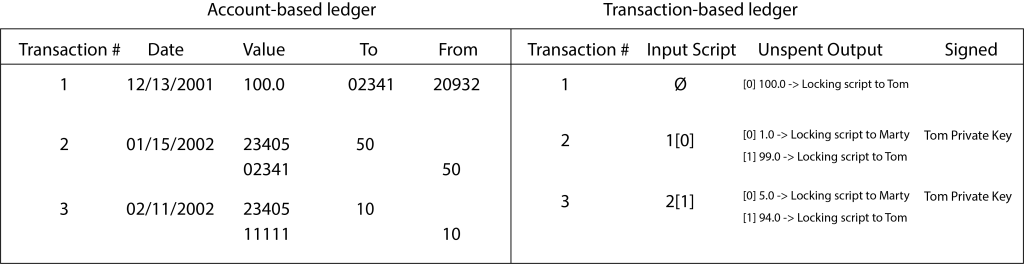
The first application of blockchain was demonstrated in currency through the inception of bitcoin (the currency). This cryptocurrency essentially used the blockchain record to keep track of transactions through a transaction-based ledger, differing from the account-based ledger. An example of the account-based ledger concept is shown in figure 1. A transaction-based ledger consists of various properties. Two of which, that are most important, are inputs and outputs. The input to a transaction includes a previous output or outputs from previous transactions. These outputs are known as UTXOs, short for unspent transaction outputs, because they have never been included in an input nor have been spent before. When the UTXOs are included in an input of a transaction, to transfer value to another entity, the input will be divided usually into two outputs. One output will be to the receiver’s public address who will be able to obtain the value in the transaction after they prove their identity by unlocking a locking script associated with the UTXO. The second output will be the change that the sender will receive after paying a specified amount to the receiver using the UTXO. If the UTXO contains the same amount needed to be spent, there will be no second output.

Figure 1. The difference between a transaction and an account-based ledger.

Like any other currency, for Bitcoin (the concept) to be viable, the people and community using it must trust that Bitcoin can be used to transact. Currently, we transact by heavily depending on third parties. These parties include banks or governments to assure a standard of fairness when transacting. The standard of fairness from centralized powers has not always been perfect or practical. Examples of imperfection include economic disasters occurring in governments such as Zimbabwe, Weimar Republic (1920), Argentina (2014), United States (2008).

The standard of fairness can be examined further on the individual level when dealing with government currencies. An example of this is the recent Ponzi scheme pulled off by Bernie Madoff, who sought investor money in return for promised profits in the future (discovered and jailed in 2008). Instead of generating profits from investments to pay investors, he took the money investors gave him and returned it, citing that the returned money was the profit. His scheme is only one of three risks. Two other risks include a bank run (when many people demand their money back all at once) and a risk of a hack. What these case studies have in common is the trust that the people have in a system of exchange.

Likewise, when aspects such as being able to join the market or use the currency effectively are barred, the trust that people have in the currency is degraded. Take, for instance, the culture in Afghanistan, which prohibits most women from banking. If they ever received any money, the women in the family would have to transfer it to the men’s bank account. An instance of being barred in joining the market might be transaction costs from sending small amounts of money throughout the world. Cryptocurrencies (which use blockchain technology) overcome both problems by lowering transaction fees, being universally acceptable, and accepting anonymity (hence anyone can join). In other words, one of the applications of blockchain, in cryptocurrency, stimulated the demand for blockchain in general.

Cryptocurrencies depend on the properties of mathematics in cryptography and transparency to overcome specific challenges that centralized systems face. Take, for example, the minimum reserve requirement that governments impose on banks, which is usually between 3-10%. A Bitcoin exchange or someone who holds bitcoins can use cryptography to reassure customers that they have a fractional reserve. This fractional reserve is calculated by a process known as proof of reserve and proof of liabilities. Proof of reserve is used to prove the number of bitcoins that the exchange controls (referring to the money that can be used). Proof of liabilities is used to prove how many demand deposits from individuals the exchange holds (hence the amount owed to depositors). Dividing the proof of reserves with the proof of deposits yields the fractional reserve. Hence, the transparency created by this process would provide a great deal of security and relief to those who have done business with this exchange. The importance of such a mathematical number would be the avoidance of another Bernie Madoff attack.

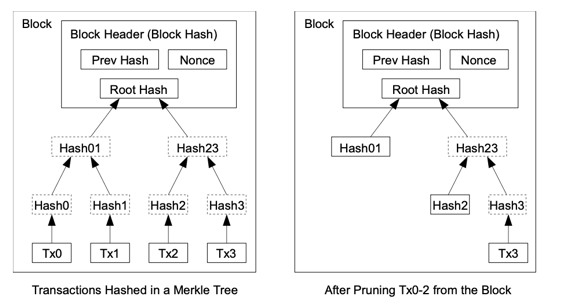
A Merkle tree can be used in the reserve verification process to cryptographically provide details of a leaf corresponding to a specific user and their transaction (known as pruning). It can also provide details of the total deposit amount that the bank has received. The transactions at the leaf of the Merkle tree contain many properties, one of which are the inputs and outputs to specific public addresses, which are all hashed to create a transaction identification. The leaf nodes are then hashed together to create non-leaf nodes (examples in figure 2 include “Hash01”, “Hash23”, or “Hash2”). This process is continued until one hash, known as the Merkle root, is created. The Merkle root is part of the Merkle tree, as it is comprised of every transaction in the block, which is represented by a single line of letters and numbers. The “Root Hash” in figure 2 is the Merkle root of the Merkle tree consisting of letters and numbers described above.

Figure 2. Example of a Merkle tree and the concept of pruning from Satoshi Nakamoto; “Bitcoin: A Peer-to-Peer Electronic Cash System”; 2008, http://www.bitcoin.org/bitcoin.pdf.

Hash functions, in general, are a core part of blockchain and cryptocurrencies. A Merkle tree is one use case of hash functions in cryptography. Useful hash functions should have three distinct properties, which include being collision-resistant, able to hide, and puzzle friendly. A hash function is collision-resistant if no one can find two distinct inputs represented by the variables x and y, such that when it is hashed, H(x) = H(y). A hash function is able to hide if there is no feasible way to figure out what the input x was if given the output of y = H(x). Finally, a hash function is puzzle friendly if it is infeasible to find x given k such that H(k∥x) = y in a certain amount of time. Having these properties enables blockchain to be distributed, yet secure in that blocks prior to the current block are immutable.

For example, a hash function that Bitcoin uses is the SHA-256, which is in the Secure Hash Algorithm family. There are many types of hash functions with different properties besides the SHA-256 algorithm, which include MD5, SHA, and RIPEMD. They differ in input and output (hash) sizes, which are measured in bits, computer logic such as XOR used to reach the hash, and general security protection against collision attacks. Therefore, in exchange for more desirable properties, there will be a reduction in other desirable properties (the three listed above). This trade and balance of cryptographic hash properties will depend on the specific application of the function, considering aspects such as the input, output, and desired security.

In general, hash functions are implemented in several areas throughout blockchain technology, such as locking and unlocking scripts, consensus protocols, and block divisions. They make up the core structure that allows blockchain to be implemented in areas dealing not only in currency, but healthcare, voting, patenting, machine learning, internet of things, and others.

Take for instance healthcare insurance. The unique use of immutability from cryptographic functions in each individual block allows legitimate participation from insurance agents, medical record managers, and patients as nodes. For instance, whenever a patient receives treatment from a hospital, the patient and the hospital will both sign the treatment on the blockchain with their private keys. This process is considered a transaction which can then be verified on the private or public blockchain network at any time. If the blockchain is a public network, any individual can join and access the blockchain data record (to review past transactions). If the blockchain is a private network, only certain individuals can join with the permission of the authorized users in the network (and review past transactions). The data stored on the blockchain is indefinite, starting from when the transaction was initiated (unless the authorized nodes all agree to void the blockchain). This means that the transaction can always be seen by participants such as insurance agents in the future. When the insurance company is ready to pay the patient’s hospital claims (or before a time set on the transaction between the hospital and patient), the company can then sign a new transaction with the hospital indicating that they have paid the claims. This case of blockchain is only in the health care insurance industry.

In the broader aspect of healthcare, regarding researchers, government, and other general healthcare companies, blockchain can be beneficial for both transparency and privacy. Depending on how the blockchain is implemented, one or the other or both can be achieved in some aspects because constructing blockchain technology is extremely malleable. An example of using blockchain to ensure privacy would be patients assigning access rules for their medical data. An example of transparency would be patients being able to collect their data by connecting to other hospitals.

Blockchain’s applications, however, have not entirely been prone to exploitations. MtGox, a bitcoin exchange based in Tokyo, Japan, at one point handled more than 70% of all bitcoin transactions. In 2014, the company announced that almost one million bitcoins belonging to customers had been likely stolen. This was because of a bug in the bitcoin protocol allowing for transaction malleability. This concept occurred when MtGox made transactions in the public ledger under specific transaction hashes. Specific nodes then altered the properties in the transaction data, which changed the transaction hash. When this was changed, the thief could complain that the transaction had failed (when it did not because the output script was still the same), and MtGox’s system would send out more bitcoins. This process could be repeated infinitely. However, it was not entirely MtGox’s fault in losing the number of bitcoins it did to the thief as the protocol had allowed nodes to change specific properties.

The first lesson to be learned from MtGox is that blockchain is present in matters dealing with money. Hence there will always be attacks on the weaknesses of blockchain attempting to distribute incentives. The second lesson to be learned is that when the code of a blockchain distributed protocol has faults or weaknesses, it should be corrected so that the faults are not exploited in the future.